Thread accuracy is a critical factor in industrial screw performance because the thread is the part that creates engagement, clamping force, alignment, and fastening reliability. For machinery manufacturers, equipment builders, electronics producers, construction buyers, and fastener distributors, accurate screw threads help reduce assembly problems, improve product consistency, and support long-term service performance.
Why Thread Accuracy Is Important for Industrial Screw Applications
What Thread Accuracy Means
Thread accuracy refers to how closely the screw thread matches the required design, standard, tolerance, pitch, angle, diameter, and fit. A screw may look acceptable from the outside, but if the thread is poorly formed, out of tolerance, damaged, or inconsistent, it can cause serious problems during installation and service.
Industrial screws are commonly produced according to recognized standards such as ISO, DIN, ANSI, JIS, or customer-specific drawings. These standards help define thread dimensions and compatibility with mating parts. For buyers, confirming thread requirements before purchasing is essential, especially when screws must fit tapped holes, nuts, inserts, or precision components.
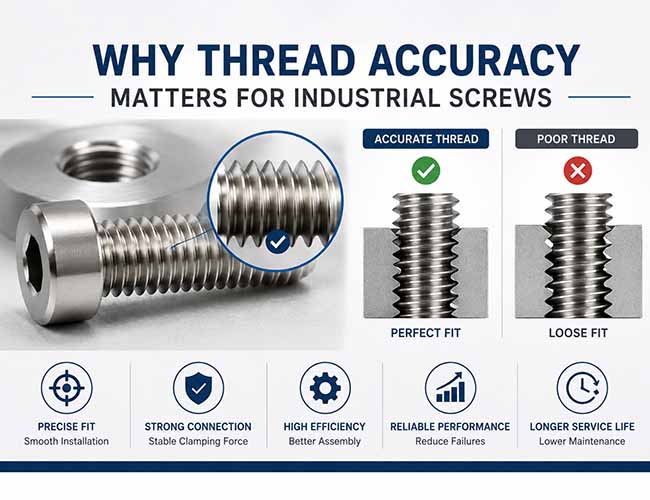
Thread Accuracy and Assembly Efficiency
Accurate threads allow screws to install smoothly and consistently. When thread pitch, diameter, or form is incorrect, the screw may become difficult to drive, cross-thread, jam, or damage the mating part. In production environments, even small thread problems can slow assembly lines and increase rejection rates.
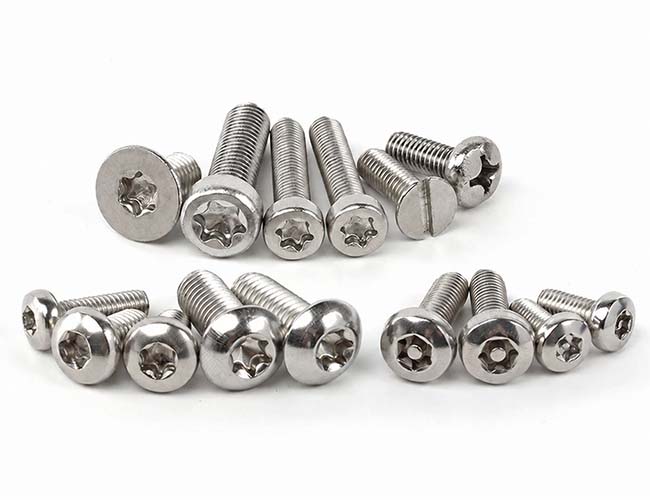
For machine screws, thread accuracy is especially important because they are designed to work with pre-tapped holes or matching nuts. If the thread does not match the mating component, workers may need extra force to install the screw, which can damage the internal thread or reduce tightening control.
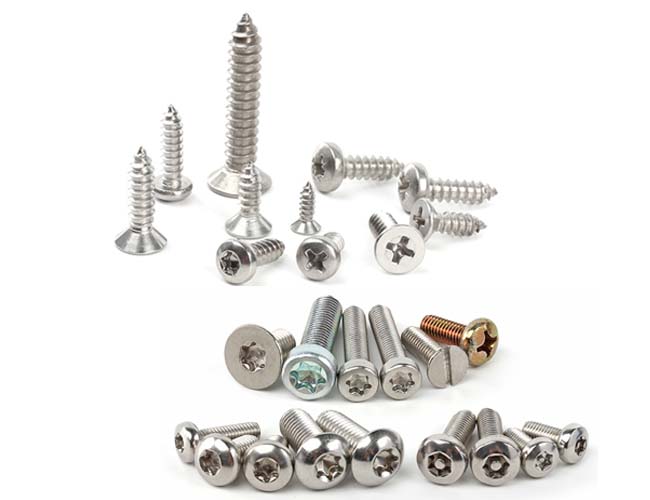
For self-tapping screws, thread design and point geometry must match the base material and pilot hole. Poor thread consistency can affect how the screw forms or cuts the mating thread, leading to unstable holding power or installation failure.
How Thread Accuracy Affects Clamping Force
The main purpose of many screws is to create clamping force between assembled parts. Thread accuracy helps ensure that tightening torque is transferred into predictable fastening performance. If the thread is rough, oversized, undersized, or poorly shaped, the torque may be lost through friction, deformation, or thread interference.
In machinery, automation equipment, brackets, panels, and structural assemblies, inconsistent clamping force can lead to loosening, vibration problems, leakage, misalignment, or premature wear. This is why industrial buyers should not judge screws only by material and appearance. Thread quality is equally important for reliable fastening.
Thread Fit and Compatibility With Mating Parts
Thread accuracy also affects compatibility. A screw must match the internal thread or nut not only by nominal size, but also by pitch and tolerance class. For example, a metric screw and an imperial screw may appear similar in diameter but will not fit correctly if the pitch is different.
Using an incorrect thread type can damage both the screw and the mating part. In precision equipment, this can result in expensive repairs or scrapped components. For distributors and OEM buyers, maintaining clear specifications helps prevent mixing incompatible products in inventory or production.
Impact on Strength and Load Capacity
The strength of a screw connection depends partly on proper thread engagement. If the thread is too shallow, incomplete, damaged, or uneven, the load may not be distributed correctly across the engaged threads. This can increase the risk of stripping, loosening, or failure under load.
Thread accuracy is especially important in applications involving vibration, repeated assembly, heavy loads, or safety-related equipment. Screws used in machinery, automotive components, industrial enclosures, tooling, and electrical equipment must maintain stable engagement under real working conditions.
Thread Accuracy in Stainless Steel Screws
Stainless steel screws are often used in corrosive or visible applications, but they still require accurate threads to perform properly. Because stainless steel can have different friction behavior compared with some coated carbon steel fasteners, thread consistency and surface quality can affect installation feel and tightening performance.
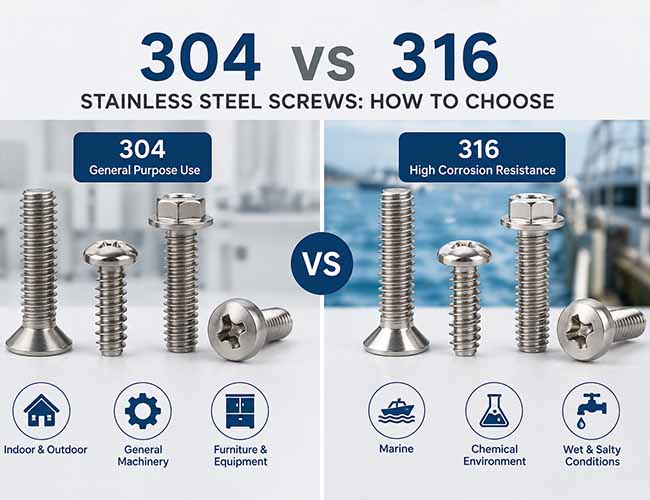
304 stainless steel screws are commonly used for general corrosion-resistant applications, while 316 stainless steel screws are often selected for marine, coastal, chemical, and washdown environments. In both cases, accurate threading is important for smooth assembly and dependable service.
Common Thread Problems Buyers Should Watch For
Common thread problems include incorrect pitch, burrs, rough surfaces, incomplete thread formation, damaged first threads, inconsistent major or minor diameter, and mixed thread standards. These issues may cause installation difficulty, poor engagement, unstable torque, or damage to mating parts.
Buyers should also pay attention to thread cleanliness, especially for screws used in precision equipment, electronics, food equipment, or assemblies that require smooth installation. Contaminants, plating buildup, or surface defects can interfere with fit and performance.
How to Specify Thread Requirements Clearly
To avoid thread-related problems, buyers should provide complete screw specifications when requesting quotations. Important information includes screw diameter, thread pitch, thread length, overall length, thread standard, tolerance class, head style, drive type, material, coating, and application environment.
For custom screws, technical drawings are especially useful. A drawing can define dimensions, thread details, tolerances, surface treatment, and inspection requirements. Samples may also help confirm practical assembly performance before bulk production.
Quality Control for Thread Accuracy
Thread accuracy should be checked during production and before shipment. Common inspection methods may include thread gauges, ring gauges, plug gauges, visual inspection, dimensional measurement, and functional fit checks depending on the product type and requirement.
For industrial buyers, consistent quality control helps reduce the risk of assembly delays, product returns, and field performance issues. Clear inspection standards are especially important for OEM projects, custom screws, and fasteners used in demanding environments.
Choosing a Supplier for Accurate Industrial Screws
Reliable thread quality depends on stable manufacturing, suitable tooling, correct material selection, and proper inspection. Buyers should work with suppliers that can understand standards, drawings, materials, coatings, and application requirements rather than focusing only on low unit price.
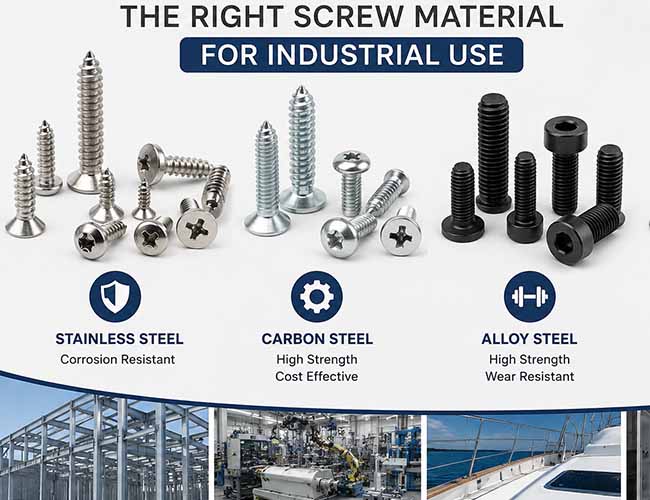
Flybear Screw supports industrial buyers with machine screws, self-tapping screws, stainless steel screws, carbon steel screws, alloy steel screws, standard fasteners, and custom screw solutions for machinery, construction, electronics, furniture, and equipment applications.
In summary, thread accuracy matters because it affects assembly efficiency, thread fit, clamping force, strength, compatibility, and long-term reliability. For industrial screws, a small thread error can create large production and performance problems. By specifying thread requirements clearly and choosing properly controlled fasteners, buyers can improve fastening quality and reduce avoidable risks.