Screw material selection is one of the most important decisions in industrial fastening because the material directly affects corrosion resistance, strength, service life, appearance, and total procurement cost. For machinery manufacturers, equipment builders, construction buyers, and distributors, choosing the right screw material helps reduce assembly failure, maintenance issues, and unnecessary replacement costs.
How to Choose the Right Screw Material for Industrial Applications
Why Screw Material Selection Matters
Industrial screws are used in many working conditions, from dry indoor equipment to outdoor construction, food processing machinery, marine hardware, chemical facilities, and electrical products. A screw that performs well in one environment may not be suitable for another. For example, a zinc-plated carbon steel screw may be cost-effective for indoor use, while a stainless steel screw may be better for humid or corrosive environments.
The correct material should match the application environment, mechanical load, mating material, installation method, and expected service life. Buyers should also consider whether the screw will be removed frequently, exposed to vibration, cleaned with chemicals, or installed in a visible location where appearance matters.
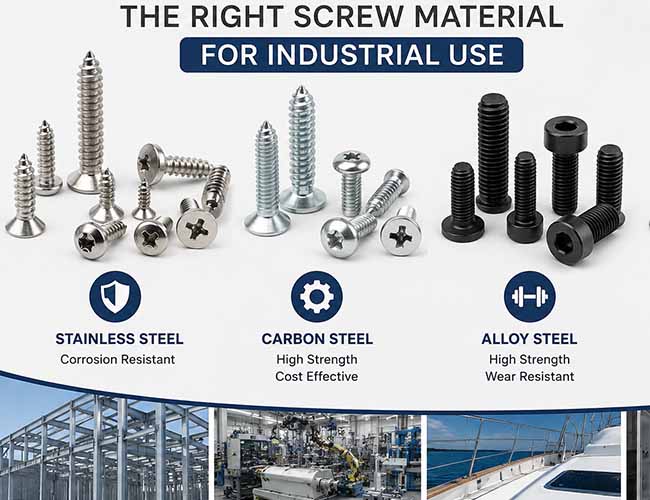
Carbon Steel Screws for General Industrial Use
Carbon steel screws are widely used in industrial applications because they offer good strength and cost efficiency. They are commonly selected for machinery, brackets, frames, equipment housings, furniture hardware, automotive parts, and general assembly work.
Because carbon steel can corrode when exposed to moisture, it is often supplied with surface treatments such as zinc plating, black oxide, nickel plating, phosphate coating, or other protective finishes. The right coating depends on the working environment, required appearance, and corrosion resistance level.
Carbon steel screws are a practical choice for dry indoor environments or applications where strength and cost control are the main priorities. However, for outdoor, humid, marine, or chemical environments, buyers should carefully review whether the coating is sufficient for long-term use.
Stainless Steel Screws for Corrosion Resistance
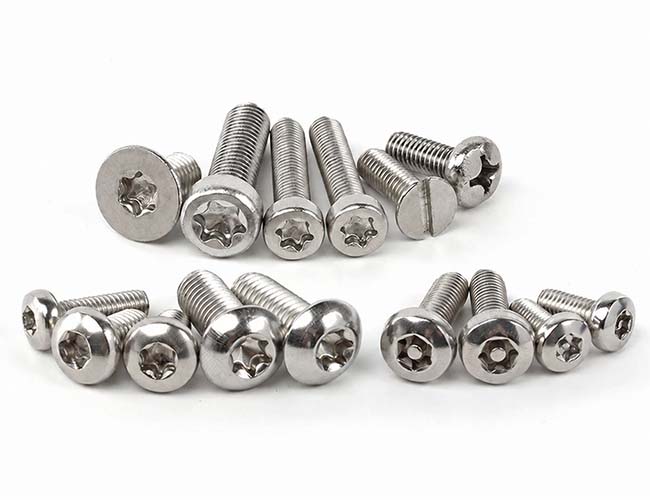
Stainless steel screws are selected when corrosion resistance and a clean appearance are important. They are widely used in outdoor construction, food processing equipment, medical equipment, marine hardware, electrical enclosures, kitchen equipment, and industrial machinery exposed to moisture.
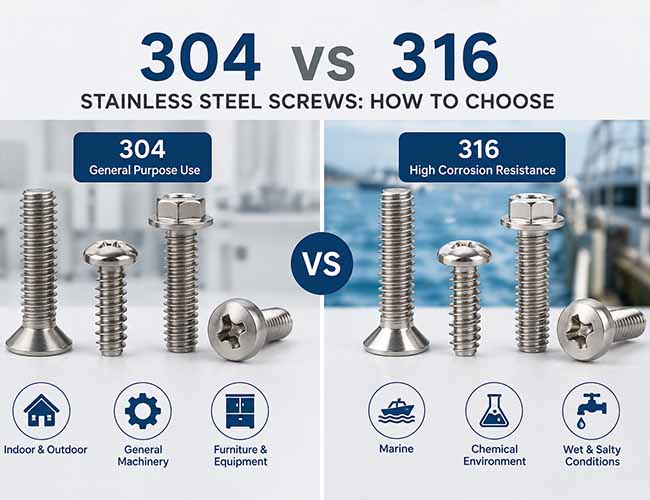
304 stainless steel screws are suitable for many general corrosion-resistant applications, including indoor equipment, building hardware, panels, furniture, and commercial products. 316 stainless steel screws provide stronger resistance in chloride-rich or harsh environments, making them a common choice for marine, coastal, chemical, and washdown applications.
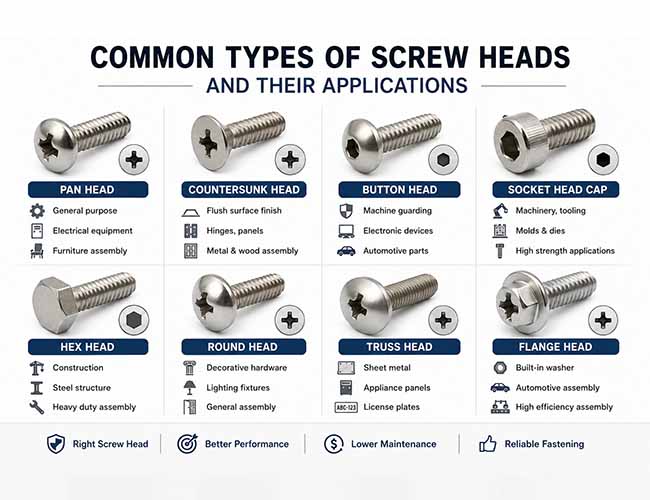
When choosing stainless steel screws, buyers should confirm the grade, head type, drive type, thread form, standard, and finish. Stainless steel can be an excellent choice for long-term performance, but it should still be matched carefully to the environment and mechanical requirements.
Alloy Steel Screws for High-Strength Requirements
Alloy steel screws are often used where higher strength, wear resistance, or heavy-duty performance is required. They are common in machinery, tooling, automotive, industrial equipment, molds, and structural assemblies that require strong clamping force.
Many socket head cap screws, set screws, and high-strength bolts are made from alloy steel and may be heat treated to improve mechanical performance. These screws are often finished with black oxide, zinc plating, or other coatings depending on the environment.
Alloy steel can offer excellent mechanical strength, but it may require surface protection if corrosion resistance is needed. Buyers should not select alloy steel only based on strength; the operating environment and coating should also be considered.
Brass, Aluminum, and Other Special Materials
Some industrial applications require screw materials with special properties. Brass screws are often used for electrical components, decorative hardware, instruments, and applications where conductivity or corrosion resistance in mild environments is useful. They are also valued for their appearance and machinability.
Aluminum screws are lightweight and corrosion resistant in certain environments, making them suitable for applications where weight reduction is important. However, aluminum screws are generally not chosen for high-strength fastening unless the design specifically allows for it.
Other materials, including titanium, copper, and special alloys, may be used in demanding or specialized industries. These materials are usually selected according to specific engineering requirements rather than general-purpose fastening needs.
Match the Screw Material to the Application Environment
The working environment should be the first factor in screw material selection. For dry indoor applications, carbon steel with a suitable finish may provide good value. For humid or outdoor applications, stainless steel or well-protected coated steel may be more reliable. For marine and coastal environments, 316 stainless steel is often preferred because of its improved resistance to salt-related corrosion.
In food processing or hygienic equipment, stainless steel is usually selected because it supports clean surfaces and corrosion resistance during frequent washing. In chemical equipment, buyers should confirm compatibility between the screw material and the chemicals used in the process or cleaning cycle.
Consider Strength, Thread Type, and Installation Method
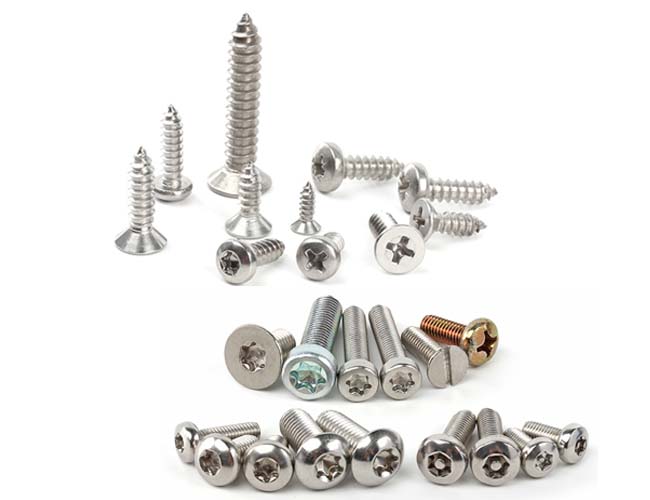
Material is only one part of screw selection. Buyers must also confirm whether the screw needs to carry load, resist vibration, provide clamping force, or support repeated assembly and disassembly. Machine screws, self-tapping screws, self-drilling screws, socket screws, wood screws, and custom screws all have different design requirements.
The mating material also matters. A screw used in steel, aluminum, plastic, wood, or composite material may require a different thread design or point style. For self-tapping screws, pilot hole size and material thickness are especially important. For machine screws, the tapped hole or nut must match the screw thread accurately.
Balance Cost and Long-Term Performance
The cheapest screw material is not always the most economical choice. If a screw corrodes, loosens, breaks, or damages the assembly, the cost of replacement and downtime can be much higher than the original fastener cost. Industrial buyers should compare material cost with service conditions, maintenance expectations, and product life requirements.
For distributors and OEM buyers, it is also important to maintain consistent specifications across orders. Clear drawings, material grades, standards, surface treatment requirements, and packaging instructions can help improve sourcing accuracy and reduce quality disputes.
Working With a Screw Supplier
Choosing the right screw material is easier when the application details are clear. Buyers should provide information such as operating environment, base material, required standard, screw size, thread type, head style, drive type, coating, and expected use. Samples or technical drawings can also help confirm the correct fastener design.
Flybear Screw supports industrial buyers with stainless steel screws, carbon steel screws, alloy steel screws, standard fasteners, and custom screw solutions for machinery, construction, equipment, electronics, furniture, and commercial applications.
In summary, the right screw material depends on corrosion resistance, strength, environment, installation method, cost, and long-term reliability. Carbon steel is practical for many general industrial uses, stainless steel is preferred for corrosion resistance, alloy steel is suitable for high-strength applications, and special materials are used when unique performance is required. By reviewing the complete application conditions before purchasing, buyers can select screws that perform reliably in real industrial use.